
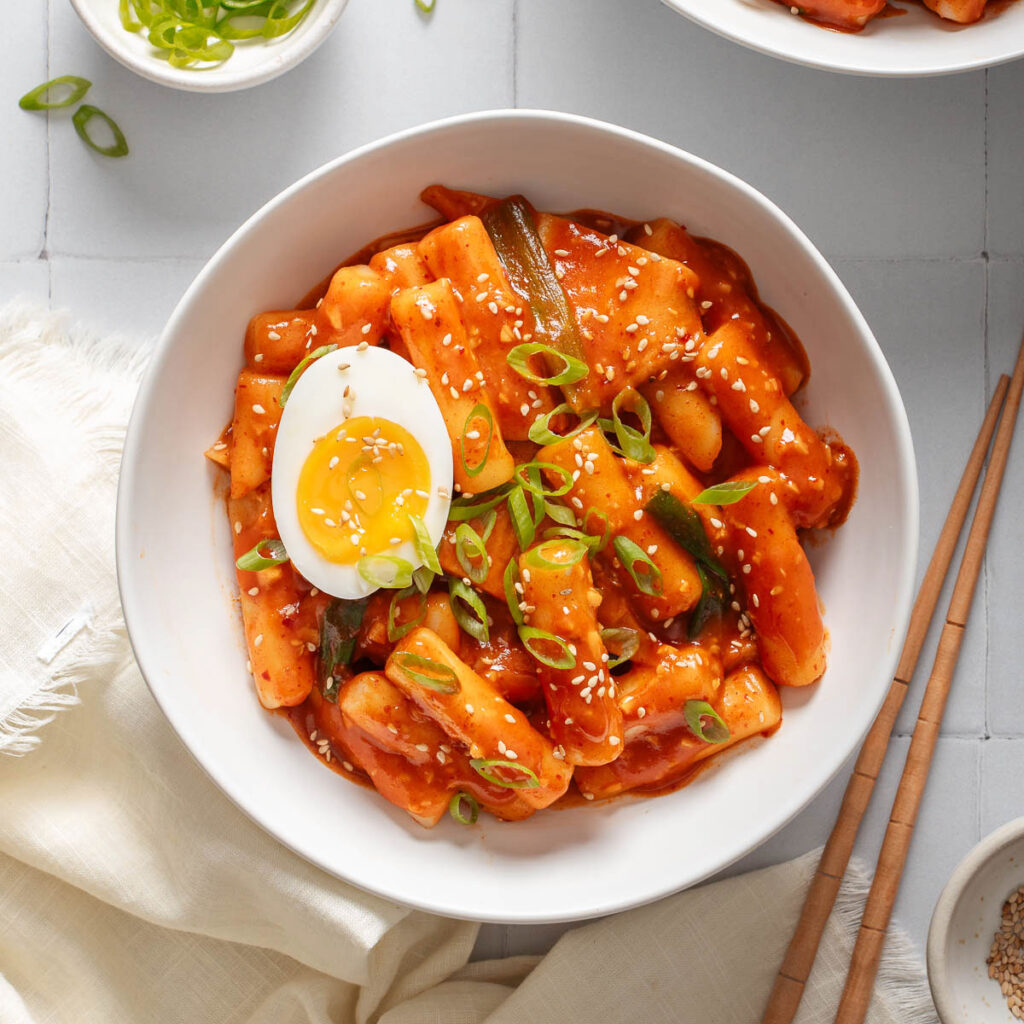
Tteokbokki has never changed to a single flavor, a single decade or even a single identity, and its many perspectives become even more fascinating when you follow its shape shifting journey through history.
Long before it was fiery red. It was royal. In the kitchens of the Joseon Dynasty, gungjung tteobokki appeared as a mild, soy-sauce glazed stir-fry of rice cakes, beef, and vegetables. No heat. No gochujang. Over time that royal dish faded from everyday life until the 1950s, when Korean street vendors reinvented it with a single, thrilling decision: add gochujang. Suddenly, tteobokki exploded back into the public imagination, this time dressed in the iconic red that would become a national symbol of comfort and modern Korean flavor.
Inside Korea the verdict appears clear. A 2023 industrial analysis shows that spicy tteokbokki continues to dominate the domestic market holding the largest and fastest growing share. Yet the moment you step outside Korea, the story twists. International audiences are increasingly drawn toward sweet, mild, cheese, fusion, and sweet-spicy variants. Proof that global curiosity is reshaping a once singular classic into a kaleidoscope of tastes.
Which brings us to the people who eat it.
For some Koreans there is no debate. Daniel Kim is certain: for tteokbokki to be itself it has to be spicy. To him, the red heat of gochujang isn’t just a sauce it’s a piece of cultural identity
Ria Chae echoes this feeling: “Spicy food is a fundamental part of Korean identity.” For them, sweetness isn’t just a flavor shift, it’s a move away from the energetic punch that modern Korean cuisine is known for.
But not everyone sees tteokbooki through that lens. Across the sea in China, Johnny Fang regularly encounters sweet versions in Korean restaurants and doesn’t associate food exclusively with heat. He even prefers Korean rice cakes into Chinese ones a reminder that food evolves not only across centuries, but across borders and expectations
Dr Hyunjoo Park, a professor of Korean culinary history, adds context that ties these viewpoints together:
”The explosive rice of spicy tteokbokki cemented it as the food of the people. The heat symbolizes vitality and post-war reliance, making sweetness feel nostalgic, almost old world”
And then there’s the science, the quiet force shaping every bite.
Capsacionoids , the compounds behind the burn, dissolve easily in fats and sugars. Sweetness doesn’t fight the heat; it tames it, smoothing its edges so that the deep fermented notes of gochujang can rise to the surface. Chemistry explains what culture has long practiced: sometimes the beast heat is the heat you choose to keep.
Tteokbokki is no longer one dish, it is a spectrum.
Its true beauty lies in its adaptability. It can be royal or street-born, nostalgic or trendy, desert-like or volcanic. It has survived centuries, leapt across borders, and reinvented itself in every kitchen it enters.
That is the Tteokbokki Paradox:
a dish defined not by one flavor, but by its endless ability to be many.
